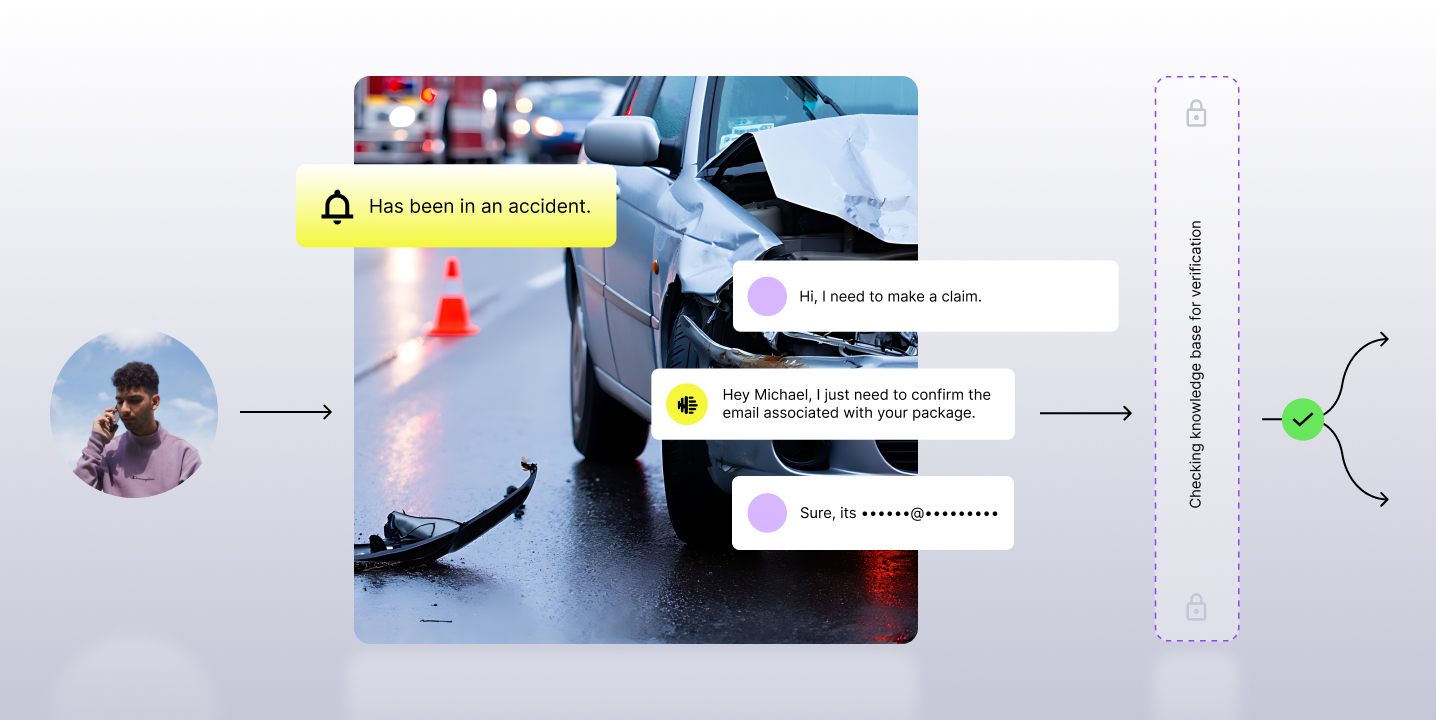
.png)
Conversational Finesse: Are You Talking to a Machine or a Human?
THE PROBLEM
Most of your calls never reach a person
Outbound voice AI (reminders, notifications, collections, and follow-ups) carries a quiet, uncomfortable truth: the person you are calling usually is not the one who picks up. Across outbound campaigns a live human answers only about 2% to 10% of calls. The rest are answered by something automated.
This makes one simple question critical: are you talking to a machine or a human? Answering it is what call screening does. Get it right and the Voice AI agent can leave a clean message or hold a real conversation. Get it wrong and it either hangs up on a live person or talks to a machine.
Call screening is exactly that job: within the first seconds of a connected call, it works out whether the line is a real conversation or an automated system, then handles each correctly. Classically this was treated as a cost-control reflex: screen the call, and if no person is there, drop it.
THE GAP
Detect-and-drop was built for humans, not Voice AI agents
The industry approach to call screening is to return a verdict as fast as possible and act on it. Platforms listen for three cues: initial silence, greeting cadence (a person says “Hello?” and pauses, while an automated greeting runs longer and steadier), and the terminating beep. They then label the call as a person or as automated, and if no one is there, they hang up. Most commercial providers report roughly 90% accuracy at three to five seconds.
Two things go wrong when the caller is a bot rather than a person.
First, accuracy leaks where it hurts. In our own production, previously a leading commercial telephony provider let over 33% of automated pickups through onto the platform, where the voice agent then burned different providers and computational costs talking to a recording. Every screen it misses is a wasted spend on that entire call.
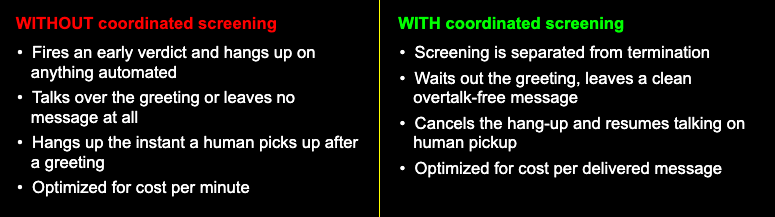
Second, the objective itself has changed. When a human agent is the scarce resource, hanging up the moment no person is there saves money. When the caller is a bot, staying on the line costs only a few cents, and a completed message still has real value: a reminder that gets acted on, or a callback that gets generated. The goal shifts from cost per connected minute to cost per delivered message. Screening that only shouts “not a person!” and drops the call cannot leave that message, and it certainly cannot recover if a human picks up two seconds later.
Screening that fires early and hangs up is only half the job. The real question isn’t just “is a person there?” It’s “what should the Voice AI agent do about it?”
OUR APPROACH
Separate the screening from the response
Good call screening is really two problems wearing one name. The screener asks whether the far end is a live person or something automated. Coordination asks what the agent should do about it (wait, speak, leave a message, or hang up), and when. Bundling them into a single early verdict is exactly why detect-and-drop feels clumsy. Our approach pulls them apart.
Three detectors, listening at once
Automated greetings vary wildly in language, in wording, and in whether they end with a beep, so no single signal catches them all. Call screening runs three complementary detectors at once, and flags the call as a machine the moment any one of them fires. The beep detector listens for the short, near-pure tone that says “record now.” Because a tone is language-independent, it is often the only signal on a non-English greeting or a content-sparse one. The keyphrase detector matches the live transcript against a list of automated-greeting phrases such as “record your message”, “after the beep”, etc. Because the words arrive as the greeting is spoken, it is usually the earliest signal. The LLM detector reads the conversation as it unfolds and recognizes paraphrased or novel greetings that no fixed phrase list would catch, including human-like AI screeners. It broadens coverage to the cases the other two miss.
A coordinator that decides when to act
Here is the part detect-and-drop skips. A positive screening does not hang up. It raises a pending signal into a coordinator, a small state machine that watches who is speaking and owns the timing of every decision. The coordinator waits out the greeting until the far end goes quiet, leaves the message as a single clean turn without talking over the recording, waits a brief grace period, and only then terminates.
Crucially, if a real person speaks while the agent is leaving its message, the coordinator cancels the hang-up and lets the conversation continue naturally. The same design waits out multi-part greetings and carrier prompts instead of mistaking each new prompt for a human pickup.
THE NUMBERS
What it looks like in evaluation and production
On a public Telephony-AMD dataset (spanning English, Spanish, French, and German), the combined system never once fired on a human clip (zero false positives), while catching all but a handful of automated pickups. The beep detector was stress-tested separately, on a different public corpus made entirely of everyday human speech (Common Voice). Across 16,401 human clips, it false-alarmed on just 0.14% of them.

Before, on live outbound traffic, a commercial provider let more than a third of automated pickups slip through to the agent, which then spent telephony and compute talking to a recording. Now, our call screener with coordinated screening recovers instead of dropping. It rescued the small slice of conversations that were first screened as automated and then answered by a real person.

THE DIFFERENCE
What changes when screening also coordinates
The shift is from a reflex that protects against a live human answering, to a policy that gets value out of every call however it is answered.
THE FRONTIER
The hard cases that matter
Screening is largely solved. The interesting problems now live on the coordination side, and several only exist because an autonomous machine is on the line. Automated menus keep emitting prompts (“press one for more options”) that repeatedly reset the agent’s wait, so it restarts its message and never finishes. AI screeners mimic a person so convincingly that nothing fires and the agent ends up talking to another bot. These are the frontier for screening-aware voice AI agents.
SUMMARY
Call screening, knowing whether you've reached a machine or a human, began as a simple reflex: decide fast, then hang up on anything that isn't a human. For an autonomous voice AI agent, that reflex quietly wastes value, dropping calls it could have put to use. The shift is to stop treating screening as one verdict and split it in two: first work out what actually answered, then decide what to do about it. Instead of hanging up, the agent waits out the greeting, leaves a clean message when it reaches a machine, and goes back into a real conversation the moment a person picks up. That is what turns every answered call, whoever or whatever answers, into one worth making.
Subscribe to our newsletter.
Frequently Answered Questions


.png)
.png)

.png)