.png)
The Next Era of Customer Experience Will Be Agentic
For more than a decade, customer experience technology has been built around one central idea: help people do their jobs faster.
We gave customer service teams better dashboards. Better workflows. Better analytics. Better routing. Better knowledge bases. Better coaching tools. All of it mattered. All of it helped. But the basic model stayed the same.
Humans still operated the system.
A customer called in. A human agent interpreted the need. A human agent searched for information. A human agent moved between systems. A human agent followed the policy. A human agent documented the call. A supervisor reviewed a sample of interactions. A QA team found patterns after the fact. An operations team tried to turn those findings into action.
Software improved the work, but people still carried most of the operational burden.
That model has changed.
The future of customer experience will not be defined by software that helps people do the work. It will be defined by AI systems that can do the work end-to-end, with humans providing oversight where judgment, empathy, or exception handling is required. That is the shift from traditional CX software to Agentic CX.
Many companies are approaching this shift by bolting LLMs onto existing products. They are adding AI features to legacy workflows, wrapping copilots around old interfaces, or using generative AI to make existing tools feel more modern.
We decided to take a different path.
We went back to first principles and asked a more fundamental question: if you were building customer experience software today, with AI agents as the primary way work gets done, what would the platform need to look like?
The answer is not a traditional application with AI added on top. It is a new architecture for CX, where specialized agents can understand work, access the right context, coordinate across systems, take action, and improve through continuous evaluation.
That is the direction we are taking Observe.AI.
We are launching the new Observe.AI platform built around a full agentic model for customer experience, bringing together AI Agents for Customers, AI Agents for Frontline Teams, and AI Agents for Operations. Together, they create a coordinated system of specialized agents that can handle customer conversations, support human employees, and automate the operational work required to improve service at scale.
This is a major shift for our company. It is also the natural evolution of why we started Observe.AI in the first place.
Customer experience has always been one of the most operationally complex parts of the enterprise. Every day, millions of conversations happen across voice, chat, email, messaging, and digital channels. Each conversation contains intent, emotion, compliance risk, product feedback, policy friction, revenue opportunity, and operational signal.
For years, enterprises have tried to manage that complexity through more tools, more dashboards, more workflows, and more people. But complexity keeps growing. Customer expectations are higher. Contact volumes are unpredictable. Compliance requirements are stricter. Labor models are under pressure. Leaders are being asked to improve service quality while reducing cost and increasing consistency.
The answer is not another dashboard. The answer is a new operating model.
Agentic CX means AI agents are not just generating responses or summarizing conversations. They are responsible for completing specific jobs. They understand the task. They gather the context they need. They reason through the next steps. They call systems and tools. They take action. They complete workflows. They deliver measurable outcomes. And they can be evaluated, governed, and improved over time.
It's the last part that matters.
Enterprise CX does not need AI that is impressive in a demo but unreliable in production. It needs AI that can operate safely inside real customer environments, where conversations are messy, systems are fragmented, policies are complex, and trust matters.
This is why Observe.AI is not simply adding agents as features. We are building a purpose-built Agentic CX platform.
The platform is the foundation. The agents are the workforce.
Our platform provides the core infrastructure needed to build, deploy, coordinate, evaluate, and improve AI agents across customer experience. That includes agent design, orchestration, integrations, tool calling, simulation, evaluation, governance, and continuous improvement. On top of that platform, enterprises can deploy specialized agents that own specific jobs across the CX lifecycle.
The first category is AI Agents for Customers
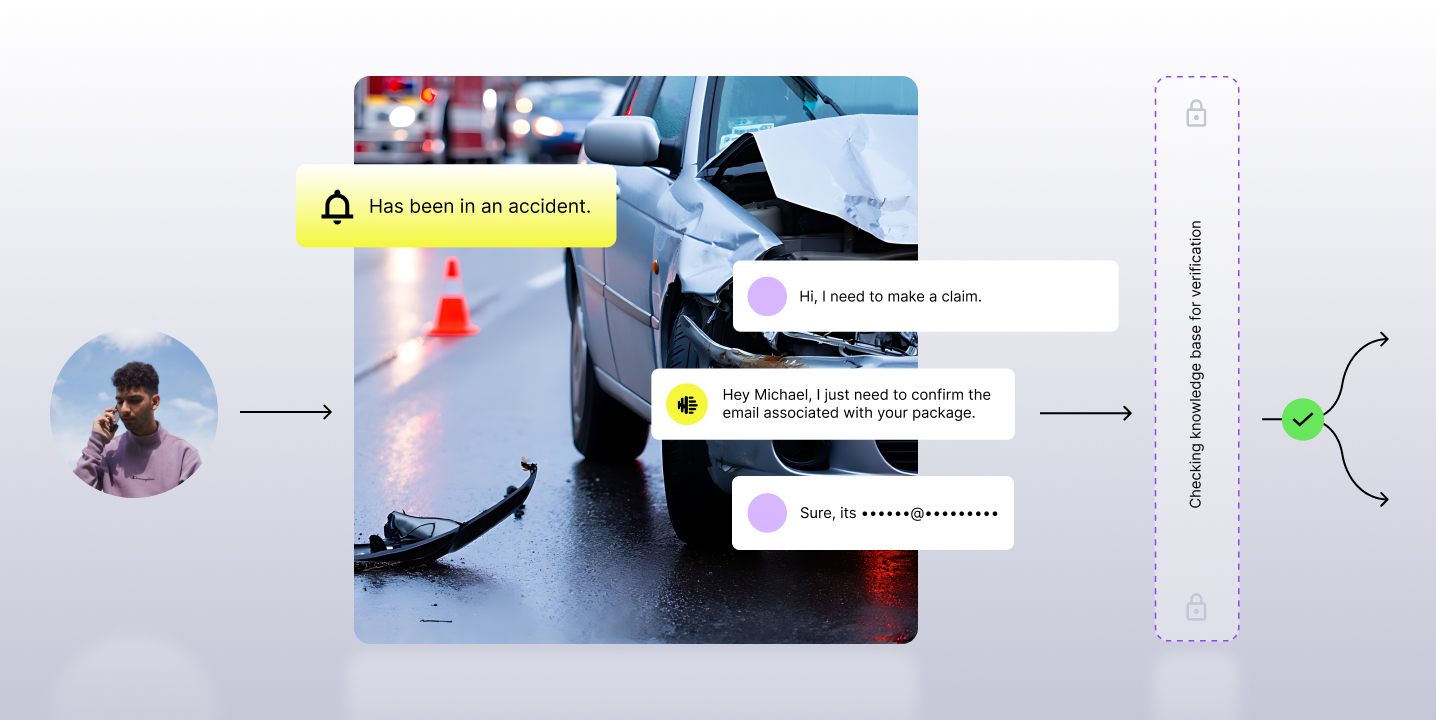
These agents engage directly with customers across voice and digital channels. They are designed to handle customer-facing service work end-to-end. That could mean answering an inbound call, authenticating a customer, understanding intent, resolving a service request, scheduling an appointment, checking eligibility, updating account information, completing a renewal workflow, or routing a customer to the right frontline team member with full context.
This is where many enterprises will first experience the impact of Agentic CX.
For too long, customers have been forced through rigid IVRs, long hold times, disconnected chatbots, and repetitive handoffs. The promise of AI is not simply to deflect more calls. It is to deliver faster, more natural, more consistent service across the moments that matter.
Customer-facing AI agents should be able to understand real conversations, not just clean text prompts. They should be able to handle ambiguity. They should know when to continue autonomously and when to involve a human. They should be able to access systems, complete tasks, and return outcomes that customers can actually feel.
In voice, this is especially important. Voice remains the highest-stakes channel in customer experience. It is where urgency, emotion, complexity, and trust often come together. Building AI agents for voice is not the same as building a chatbot. It requires deep comprehension, real-time orchestration, reliable workflow execution, and strong guardrails.
That is why we believe Observe.AI is uniquely positioned for this next phase. We have spent years learning from real customer conversations and operational environments. We understand the difference between AI that can talk and AI that can complete work.
The second category is AI Agents for Frontline Teams
Even as customer-facing agents take on more work, human agents will remain essential to customer experience. But their role will change.
The frontline team of the future will not spend as much time searching for knowledge, taking notes, filling out forms, or trying to remember the right policy in the middle of a complex interaction. AI agents will take on more of that cognitive and administrative load so humans can focus on judgment, empathy, and resolution.
Frontline team agents will support employees before, during, and after the customer conversation.
Before a conversation begins, a pre-call insights agent can surface the customer’s history, likely intent, relevant context, and potential risks. During the interaction, a knowledge agent can provide the right guidance in the moment, based on what is actually happening in the conversation. A data extraction agent can capture important information automatically instead of forcing the agent to document everything manually. After the call, an aftercall agent can generate summaries, update records, trigger follow-up workflows, and reduce after-call work.
This is more than assistance. It is a new way to operate the frontline.
The goal is not to replace human agents in every situation. The goal is to make every frontline team member more consistent, more informed, and more effective. In many enterprises, the difference between a great customer experience and a poor one depends on whether an agent can find the right answer, follow the right process, and capture the right information under pressure. AI agents can help make that level of performance available to every employee, not just the most experienced ones.
They can also create a better experience for the frontline itself.
Customer service work is difficult. Frontline teams are expected to navigate complex systems, emotional customers, changing policies, compliance requirements, and performance expectations in real time. When AI handles the repetitive work around the frontline teams, the job becomes more human, not less. Employees can focus on the moments where they add the most value.
The third category is AI Agents for Operations
This is one of the most important and underappreciated parts of the shift to Agentic CX.
Customer experience does not improve just because conversations are automated. It improves when organizations can understand what is happening, evaluate performance, identify gaps, coach teams, fix processes, and govern outcomes continuously.
Today, much of that work is manual. QA teams review a small sample of interactions. Supervisors spend hours preparing coaching plans. Operations leaders wait for reports. Compliance risks are often identified after the fact. Valuable insights sit inside conversations, but do not become action quickly enough.
AI agents can change it all.
Operations agents can evaluate interactions automatically for quality, compliance, and workflow adherence. They can generate coaching recommendations based on actual performance signals. They can identify trends, root causes, policy breakdowns, customer pain points, and opportunities for improvement. They can help leaders understand not only what happened, but what needs to change.
This is where our heritage in Conversation Intelligence becomes a major advantage.
Observe.AI has helped enterprises analyze, evaluate, and improve customer conversations at scale. Now we are extending that foundation into a more agentic model. Capabilities like AI Evaluator, AI Coaching, and AI Auditor are part of this evolution. They move operational teams from reviewing and reacting to continuously improving with AI-powered execution.
The future of Conversation Intelligence is not just insight. It is action.
That is a key belief behind our platform strategy. CX leaders do not need more disconnected analytics. They need systems that can turn interaction data into operational improvement. They need AI that can evaluate, recommend, coach, audit, and trigger the next best action.
The Unified Agentic Platform Across the Entire Customer Experience Lifecycle
When AI Agents for Customers, Frontline Teams, and Operations work together, the customer experience starts to look very different.
A customer-facing agent autonomously resolves a routine issue. A frontline team agent supports a customer on a more complex or high-priority case. An operations agent evaluates both interactions, identifies process gaps, generates coaching, and coaches the agent through sharing materials and role-play. The system learns. The business improves. The next interaction gets better.
That is the power of a coordinated multi-agent platform.
No single agent should own the entire customer experience. CX is too complex for one generic AI system. It requires specialization. One agent may be responsible for authentication. Another for routing. Another for knowledge retrieval. Another for documentation. Another for QA. Another for coaching. Another for insights. Each agent has a defined role, clear accountability, access to the right tools, and a way to be measured. This is how enterprises will safely scale AI.
The early phase of enterprise AI was about experimentation. Teams launched pilots, tested models, built demos, and explored use cases. That phase was necessary. But the next phase is about production. It is about measurable outcomes, reliability, governance, and scale.
In customer experience, the bar is high. AI agents must work across real channels, real customers, real systems, and real business rules. They must handle edge cases. They must be tested before deployment. They must be monitored after deployment. They must follow policies. They must know when to hand off. They must improve without creating risk.
This is why a unified platform matters.
An agent without evaluation is a risk. An agent without integrations is a conversation layer. An agent without orchestration is a point solution. An agent without governance is not ready for the enterprise.
Observe.AI is building for the full operating model, not a narrow use case. We are building the platform for Agentic CX because we believe the next generation of customer experience will be powered by specialized AI agents working together across the enterprise.
This shift will also change how companies think about the contact center itself.
The contact center has often been treated as a cost center. A place to manage volume, reduce handle time, and contain issues. Agentic CX creates a different possibility.
When every conversation can be understood, every workflow can be automated where appropriate, every human agent can be supported in real time, and every operational signal can be turned into action, the contact center becomes a learning system for the business. It becomes a place where customer needs, product issues, policy gaps, compliance risks, revenue opportunities, and employee performance signals are continuously captured and improved.
That is a much bigger vision than automation alone.
Yes, AI agents can reduce costs. Yes, they can improve efficiency. Yes, they can help companies scale service without adding headcount at the same rate. Those outcomes matter. But the larger opportunity is to build a customer experience operation that is more responsive, more consistent, and more intelligent over time.
That is what we mean by Agentic CX.
It is not just AI in the contact center. It is a new foundation for how customer experience work gets done.
For Observe.AI, this is both a strategic evolution and a return to our core conviction. We have always believed that customer conversations are one of the most valuable sources of intelligence in the enterprise. Now, with AI agents, that intelligence can do more than inform decisions. It can execute work. It can guide people. It can improve operations. It can deliver outcomes.
The companies that win the next decade of customer experience will not be the ones that simply add AI to old workflows. They will be the ones who rethink the work itself.
Observe.AI is becoming the Agentic CX platform for the enterprise. AI Agents for Customers. AI Agents for Frontline Teams. AI Agents for Operations. One coordinated system built for the full customer experience lifecycle.
The next era of CX will not be managed through more dashboards and manual workflows.
It will be run by AI agents, guided by humans, governed by the enterprise, and measured by outcomes. This is the future we are building.
Subscribe to our newsletter.
Frequently Answered Questions


.png)